The Cullowhee Native Plant Conference
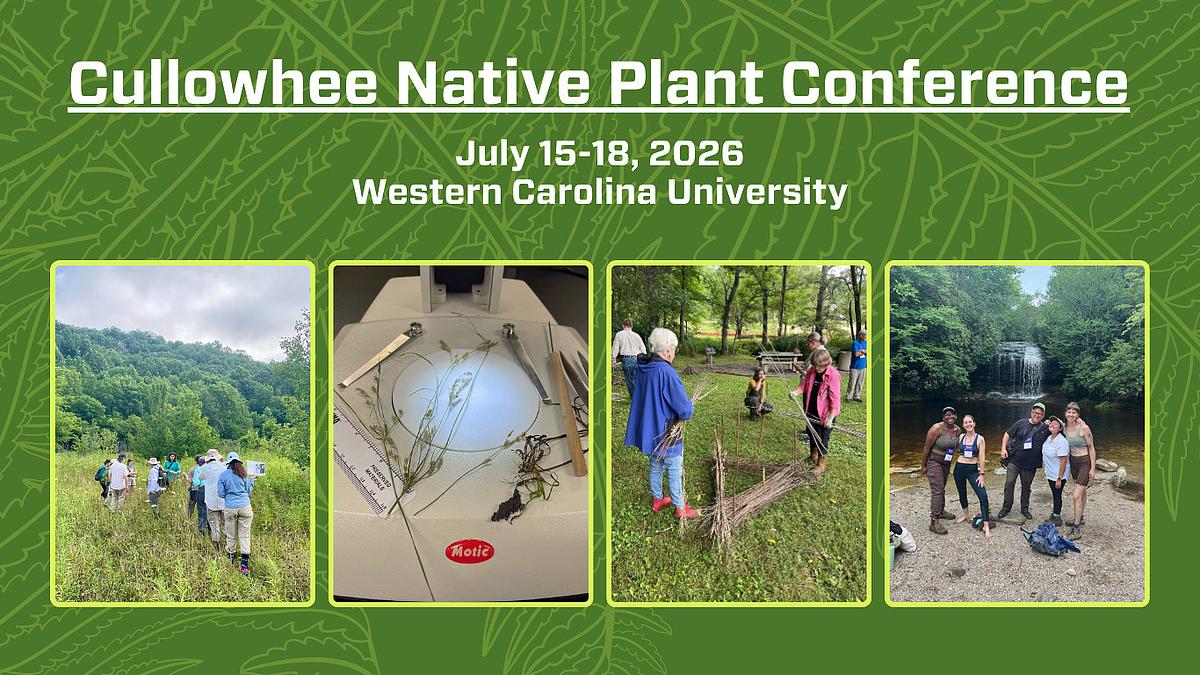
July 15-18, 2026
91ŮÉñ
Cullowhee, NC
Registration will open Wednesday, April 15, 2026 at 9:00 am.
Information on the 2026 Native Plant Conference is coming soon!
Learn More 91ŮÉñ Our Speakers & Trip Leaders
Conference Costs and On-Campus Accommodations


Program & Session Details:
7:00 am - 8:00 am - Breakfast for Wednessday Participants
7:45 am - Check-In Begins for Field Trips at Norton Residence Hall (Arrive no later
than 8:15 am)
8:30 am - 5:00 pm - Field Trips & Workshops (Descriptions in Field Trips and Workshops Section Below)
5:30 pm - 6:45 pm - Dinner for Wednesday Participants
7:00 pm - 7:30 pm - First-Timers Session
7:30 pm - 7:45 pm - Break
7:45 pm - 8:00 pm - Welcome at the Main Stage
8:00 pm - 9:00 pm - Plenary 1 – Listening to Native Plants with Holly Haworth
9:00 pm - 10:00 pm - Networking at Norton Hall
7:00 am - 8:30 am - Breakfast at Ramsey Concourse
8:00 am - 9:30 am - Vendor Walk
9:30 am - 9:45 am - Welcome at Ramsey Center
9:45 am - 10:45 am - Plenary 2 – How Can I Help? Saving Nature with Your Yard with
Doug Tallamy
10:45 am - 11:00 am - Break
11:00 am - 12:00 pm - Plenary 3 – Ten Years of Managing a Piedmont Prairie at Sarah
P Duke Gardens with Annabel Renwick
12:00 pm - 1:15 pm - Lunch
1:30 pm - 2:30 pm - Plenary 4 - Coloring the Conservation Conversation with J. Drew
Lanham
2:30 pm - 2:45 pm - Break
2:45 pm - 3:45 pm - Concurrent Sessions 1 (Click for full descriptions)
3:45 pm - 4:00 pm - Break
4:00 pm - 5:00 pm - Concurrent Sessions 2 (Click for full descriptions)
5:30 pm - 6:45 pm - Dinner
6:45 pm - 9:00 pm - Book & Plant Sales
7:30 pm - 8:30 pm - Plenary 5 – Gardening for Moths with Jim McCormac
9:00 pm - 11:00 pm - Music and Mothing with The World Famous Pancake Brothers (Ramsey
Center)
7:00 am - 8:30 am - Breakfast at Ramsey Concourse
8:00 am - 5:00 pm - Conference check-in
8:00 am - 11:45 am - Friday Morning Field Trips (Descriptions in Field Trips and Workshops
Section Below) Please note field trips leave AT 8:00 am from Ramsey Concourse. Please be early as
field trips will leave at 8:00 am sharp.
8:30 am - 11:45 am - Friday Morning Walks & Workshops (Descriptions in Field Trips and Workshops Section Below)
8:30 am - 12:00 pm - Exploring & Networking, Plant & Book Sales
12:00 pm - 1:00 pm - Lunch 'n' Learn
12:00 pm - 1:15 pm - Lunch
12:45 pm - 2:45 pm - Book & Plant Sales
1:00 pm - 2:00 pm - Poster/Display Session (Ramsey Floor)
2:00 pm - 2:15 pm - Announcements (Main Stage at Ramsey)
2:15 pm - 2:30 pm - Tom Dodd Jr. Award (Main Stage at Ramsey)
2:30 pm – 2:45 pm - Break
2:45 pm – 3:45 pm - Plenary 6 - Many Hands: Collaboration in Public Horticulture with
Thomas Woltz & Brad Odom
3:45 pm – 4:45 pm - Plenary 7 - The Flora of the Southeastern United States as Foundation
for Plant Conservation with Alan Weakley
4:45 pm – 5:00 pm - Break
5:00 pm - 6:00 pm -Book & Plant Sales
5:00 pm - Silent Auction Closes
6:00 pm - 7:00 pm - Picnic (Picnic Area)
7:15 pm - 8:30 pm - Talent Show with Jeff Jackson (Ramsey Center)
9:00 pm - 11:00 pm - Moth watch with Lenny Lampel
8:30 pm - 11:00 pm- Music (The Cullowhee Players)
7:00 am - 8:30 am - Breakfast at Ramsey Center
8:30 am – 9:30 am -Plenary 8 - Writing "Plants of The Appalachian Trail" a Field Guide
with Dr. Kristen Wickert
9:35 am - 10:20 am - Plenary 9 – Project of Promise with Kelly Holdbrooks and Matt
Sprouse
10:30 am - 11:30 am - Plenary 10 – Plants of Promise with Katie Davis
11:30 am – 11:40 am - Closing Comments
11:30 am – 1:00 pm - Book & Plant Sales
1:00 p.m. - Conference Ends
Native Plant Conference Field Trips and Workshops
ALL FIELD TRIPS WILL LEAVE ON TIME. PLEASE ARRIVE EARLY TO BE CHECKED IN, RECEIVE
YOUR LUNCH, AND BE LOADED ON THE BUS BY 8:30 AM
Destinations may be subject to change depending on site availability due to Hurricane
Helene
Wednesday (full day) Field Trips = $150 (Please note select field trips have additional
costs for equipment rentals. They are noted in the field trip descriptions)
Field Trip 1 (20 max) – Blue Ridge Grassland Communities
Leader(s): Nancy Adamson & Gary Kaufman
Difficulty Level: 3. Moderately Strenuous = trail hiking away from vehicle AND/OR
moderate elevation gain (<500') AND up to 4 miles
Join botanists/ecologists Gary Kauffman and Nancy Adamson to visit one of the most grass rich sites in western North Carolina. Managed with prescribed fire, Buck Creek’s unusual geology, serpentine dunite with higher magnesium content, supports more than 25 grass species, along with diverse wildflowers and associated wildlife. Gary previously monitored and helped to manage the site for 30 years. With Gary’s in-depth plant and cultural knowledge and Nancy’s native bee and other insect skills, we hope participants will gain a deeper appreciation for connections between people, plants, and other wildlife on this trip. The trip may be moderately strenuous due to rocky, uneven terrain and a few miles in length. Always good to bring a hand lens! We will spend at least ½ day exploring the serpentine barrens. Depending on time, we will visit a nearby rich cove forest exploring other grasses, sedges, and associated plants.
Field Trip 2 (20 max) – Exploring the Botany of Panthertown Valley
Leader(s): Tom Groves & Kara McMullen
Difficulty Level: 5. Hard = trail hiking with rough/uneven terrain AND/OR water crossings
AND/OR significant elevation gain (>800')AND miles AND over 4 miles
Explore the unique flora of Panthertown Valley (the Yosemite of the East) with a botanist and land manager. The hike will explore the land use history of this unique valley, and traverse through the granitic domes that surround the valley as well as pass by and see some of the flora associated with a rare high-elevation Southern Appalachian mountain bog/fen. Participants should expect to be in the woods all day and see some amazing plant species. The hike is roughly 8 miles round trip, with a swim at Schoolhouse Falls and a lunch break halfway through. Make sure to bring enough water, food, rain gear, and suitable footwear to be in the woods all day.
Field Trip 3 (20 max) – Botanizing on the Blue Ridge Parkway
Leader(s): Adam Bigelow & George Morris
Difficulty Level: 2. Moderate = trail walking away from vehicle AND minimal elevation
gain (<200') AND less than 1 mile
We will explore the botanical treasures along the roadsides at varied elevations on the Blue Ridge Parkway. We will have stops along the Parkway from Mountain Cove to a gravity-defying bog garden, and explore multiple ecotones within these areas, and discover the unique plants that inhabit these ecotones. We will likely see sundews, lilies, orchids, and multiple hypericums. This is an easy trip along the Blue Ridge Parkway. The weather can change rapidly on the Parkway. A light raincoat might come in handy. Little if any shade. No restroom facilities.
Field Trip 4 (18 max) – High Elevation Communities and Rare Species of the Ridgeline
Plott Balsams
Leader(s): Matt Gocke & Brandon Wheeler
Difficulty Level: 4. Strenuous = trail hiking away from vehicle AND significant elevation
gain (<800') AND up to 4 miles
Join us for an introduction to the high-elevation wonders of the Spruce-Fir forests of Western North Carolina! We will begin our journey at Waterrock Knob, one of the highest summits along the Blue Ridge Parkway. Here we will experience climate and flora reminiscent of Canadian woodlands as the extreme elevation transports us hundreds of miles north. From Waterrock we will venture towards Pinnacle Park on the Pinnacle Ridge Trail, with wonderful examples of Northern Hardwood Forest. This ridge contains a suite of species endemic to the Plott Balsams and the nearby Smokey Mountains, while also offering wonderful views of the surrounding area. Be prepared for a few rocky scrambles and undulating climbs as we maintain the ridgeline to Blackrock Mountain. This field trip includes lunch on one of the most scenic peaks in the Plott Balsam range.
Field Trip 5 (16 max) – Highlands Botanical Garden
Leader(s): Paul Manos & HBS staff
Difficulty Level: 1. Easy = in and out of a vehicle AND light walking on level ground
AND less than 1 mile
Travel to the highest public native plant botanical garden in the Eastern US. At 3,800’ Highlands Botanical Garden offers cool temperatures, prolific blooms, and botanical diversity due to the high rainfall of the region. We will peruse meadow paths, the trails of the Highlands Botanical Garden, and bog boardwalks where we will see rare wetland plants! Bring a hand lens and raincoat.
Field Trip 6 (18 max) – Sam's Knob Valley and Flat Laurel Creek Hike
Leader(s): Owen Carson & Lauri Lawson
Difficulty Level: 4. Strenuous = trail hiking away from vehicle AND significant elevation
gain (<800') AND up to 4 miles
This strenuous loop hike takes participants on a wild journey through some of WNC’s most amazing and diverse ecosystems! Beginning in the upper valley with Sam Knob looming in the distance, the rugged trail descends southward towards Flat Laurel Creek in the bottom of the valley, skirting beautiful spruce-fir forests to the east and steep, shrub-dominated balds to the west. On our way along the loop, we’ll pass through many different ecotones, including shrub balds, meadows, high-elevation bogs and seeps, northern hardwood forests, acidic coves, and more, and in transit we’ll discuss their defining characteristics, dynamics, and the interesting and uncommon plants they contain. We’ll also explore the natural and anthropogenic history of the valley and why it looks the way it does today. Hikers will take lunch beside Flat Laurel Creek and its beautiful cascades before ascending northward toward Sam Knob then back eastward to the trailhead. Participants should be prepared with plenty of water (a filter will suffice as there are many stream crossings), snacks and lunch, and gear for inclement weather; additional useful gear could include hiking poles, a hand lens, binoculars, and identification guidebooks. Potential hazards include slips/trips/falls, submerged crossings (wet boots), open, exposed terrain, and encounters with venomous snakes, stinging insects, and black bears.
Field Trip 7 (10 max) – The North Carolina Arboretum, Tour A: The Core Gardens
Leader(s): Carson Ellis & TNCA Staff
Difficulty Level:
Field Trip 8 (20 max) – Big Ridge Preserve and Amazing Grace Properties LLC
Leader(s): Rob Lance
Difficulty Level: 3. Moderately Strenuous = trail hiking away from vehicle AND/OR
moderate elevation gain (<500') AND up to 4 miles
Big Ridge Preserve is a private tract of land covering 2100 acres of forested mountainous terrain in the Big Ridge Community of Jackson County. It is not open to the general public. The group will be led on three walks by Ron Lance, Caretaker of the property. One stroll is easy, one moderate (about 0.5mile) and one moderately strenuous (near 1 mile). Natural habitats to be visited include a rock cliff, a mountain oak-hickory forest, a cove hardwood forest, and a maintained meadow with numerous native species. Interesting plants along the proposed routes include many native grasses and wildflowers, plus a diverse woody plant assemblage that includes Populus grandidentata, Amelanchier sanguinea, Lonicera flava, Crataegus schuettei, Carya pallida and white-flowered Rubus odoratus.
Field Trip 9 (20 max) – Whiteside Mountain and Highlands Garden
Leader(s): Jeff Zahner
Difficulty Level: 4. Strenuous = trail hiking away from vehicle AND significant elevation
gain (<800') AND up to 4 miles
This field trip includes a hike up Whiteside Mountain in the morning, a bagged lunch on top and then a garden tour of the old Zahner gardens in Highlands. The hike is a 2-mile loop trail that crosses a variety of habitats and offers many high-elevation species to explore plus tremendous views of the Chattooga River basin and escarpment. The mountain is home to many plant species endemic to the southern Blue Ridge Mountains and offers summer refuge to Peregrine falcons, successfully reintroduced to the high cliffs in the 1980s. After lunch on the top, we shall make our way to the old Zahner gardens in Highlands where many types of native plants have been used in the restoration of an old “formal” garden. The use of native plants in design and the long-term benefits and challenges will be discussed. Bring a pack for lunch & water plus a raincoat just in case.
Field Trip 10 (18 max) – Exploring Old Growth Groves in Joyce Kilmer-Slickrock Wilderness
Leader(s): Stephan Hart & Nicole Harris
Difficulty Level:
Join us as we stroll along an easy-to-moderate two mile loop in the Joyce Kilmer Memorial Forest, dedicated to the writer, journalist, and poet, Joyce Kilmer. Containing one of the largest stands of old growth hardwood forest in the eastern U.S., this wilderness area functions as a complex filtration system, providing carbon sequestration, water purification, and supporting a diversity of flora and fauna in the multi-layered canopy soaring above, and the deep organic soils on the forest floor below. We’ll meander through groves of spectacular, twenty-foot circumference trees, some estimated to be 400+ years old. Giant specimens of tulip poplar, basswood, sycamore, oak, magnolia, and silverbell protect a variety of understory plant life. As we drive through the Nantahala River Gorge, side stops (time permitting) may include Ledbetter Creek and the Bartram Trail; cove forest ecozones that are hotspots for endemic species. Flush toilets and picnic tables are available for lunch.
Field Trip 11 (30 max) – Panthertown Valley Botanical Hike
Leader(s): Shelby Lyn Sanders, Katie Davis, & Patrick Thompson
Difficulty Level: 5. Hard = trail hiking with rough/uneven terrain AND/OR water crossings
AND/OR significant elevation gain (>800')AND miles AND over 4 miles
Participants on this field trip will enjoy a hike through scenic Panthertown Valley. This trip will include 6 miles or more of hiking on steep and uneven terrain. The payoff will be the exploration of numerous plant communities from secluded waterfalls to exposed rock outcrop communities. We will employee a team of botanical experts to offer plant ID's along with delightful anecdotes and ecological insights to stimulate your planty little brains.
Field Trip 12 (18 max) – Touring Naturalized Landscapes with Asheville Area Meadow
Makers
Leader(s): Emily Sampson & Nathan Buchanan
Difficulty Level: 1. Easy = in and out of a vehicle AND light walking on level ground
AND less than 1 mile
Join us to visit a total of 4 meadows that have been seeded and planted with native perennial wildflowers and grasses. 2 of the meadows are greater than 2 acres, in public spaces and the other 2 are smaller meadows in residential neighborhoods. Emily Sampson (of Patchwork Meadows) and Nathan Buchanan (of Wildbud Natives) will discuss the establishment process, maintenance strategies, species composition and how each space has changed over time since it's establishment. Expect an easy walk to and around each meadow, but be prepared for hot, exposed conditions. Bring an umbrella in case of rain and/or to provide shade. Picnic lunch will be at Beaver Lake following our second meadow visit. Bring extra drinking water. Porta-jons and/or restrooms available at or between stops.
Field Trip 13 (18 max) – Native Plants and Geology of the Upstate
Leader(s): Cory Dodgens & Samantha Tessel (or Rick Huffman)
Difficulty Level: 2. Moderate = trail walking away from vehicle AND minimal elevation
gain (<200') AND less than 1 mile
In far northwestern South Carolina, the Brevard fault zone holds a vast array of rock types that yield unique plant communities. We will be examining the southern transitional zone which houses primarily mafic communities. These higher pH areas, due to the amphibolite rock in the area, host rare and diverse communities that mix species from oak/pine savannas with more forested cove species. We will see species like Echinacea laevigata and Stenanthium gramineum within a few yards of Tetragonotheca helianthoides and Spigelia marilandica!
Field Trip 14 (16 max) – Highlands-Cashiers Land Trust Properties
Leader(s): Stephanie Contreras & Andrew Renfro
Difficulty Level:
Location:
Field Trip 15 (10 max) – The North Carolina Arboretum, Tour B: The Trails
Leader(s): Carson Ellis & TNCA Staff
Difficulty Level: 3. Moderately Strenuous = trail hiking away from vehicle AND/OR
moderate elevation gain (<500') AND up to 4 miles
The North Carolina Arboretum is a 434-acre public garden located within Pisgah National Forest, just south of Asheville. Surrounded and crisscrossed by forested coves and meandering creeks in the botanically diverse Southern Appalachian Mountains, the Arboretum gives visitors a unique experience in one of North Carolina’s most beautiful natural settings. In its mission to creatively connect people and plants through place-based education and design, the cultural and natural heritages of Western North Carolina are celebrated throughout the Arboretum’s displays and landscape. The Arboretum’s 65acres of cultivated landscapes feature favorite exhibits such as a world-renowned Bonsai Collection, the Quilt Garden, and the Plants of Promise Garden. Beyond the Core Gardens, the Arboretum stewards 10 miles of trail for both hikers and cyclists. These trails traverse the Arboretum’s varied topography, taking visitors up along dry, rocky slopes, and down to the lush, shaded banks of Bent Creek. With so much to see, the Arboretum will be offering Cullowhee participants two tour experiences to choose from. Both groups will spend the morning together in the Core Gardens, visiting WillowPond and the Bonsai Collection before breaking for lunch. For those excited for a more rigorous pace and wanting to explore the Arboretum’s hiking trails and natural landscapes, Tour B participants will join Native Azalea Collection Curator Carson Ellis on a walk to the Native Azalea Collection, stopping by Forest Meadow and walking portions of the Creekside and Ethnobotany Trails. This tour will cover approximately 3 miles over varying topography and pathway surfaces, including chipped single tracks and gravel roads. To close out the day, participants will visit the Arboretum’s Support Facility where they’ll have the opportunity to see the Native Azalea Nursery, Bonsai Hoop House, and Production Greenhouses.
8:30 am - 4:45pm
Wednesday (full day) Workshops = $110
Workshop 1 (30 max) – Native Plant Propagation: Theory & Practice
Leader(s): Emily Driskill
Join native plant grower Emily Driskill to learn about propagation methods for a variety of native plant species. This workshop will cover seed and vegetative methods, including how to decide which approach to take. The seed discussion will go over sustainable collecting, conserving genetic biodiversity, cleaning, stratification, and sowing. Vegetative methods will cover stem cuttings, layering, live stakes, and division. We will go in-depth on demonstrations and hands-on practice of multiple forms of seed cleaning and vegetative methods. We will also cover some botany basics to help students understand the terminology, how, & why of our propagation methods. We will discuss ways to adapt methods to various production scales. You will leave with cuttings and seeds, a list of supplies needed to get started, and a trusty compilation of references. Please bring clean & sharp pruners or scissors if you have them, as well as any (non-invasive) seeds you’d like advice on cleaning or sowing.
Workshop 2 (12 max) – Leaf-ing Good Impressions: Casting Botanical in Cast Stone
Leader(s): Grace Buffaloe
It’s always great to leave a good impression, especially with your garden decor. Join Grace Buffaloe in this hands-on workshop where you will certainly get your hands dirty and unleash your creativity! Learn how to create beautiful and unique stone art pieces for your garden using real plant impressions; the perfect way to add a personalized touch to your landscape! You will be guided through the process from beginning to end, ensuring you leave with a wonderful product. Please bring clothes you are comfortable in and are okay with getting messy.
Workshop 3 (18 max) – An Introduction to Identifying Graminoids (Grasses, Sedges,
Rushes)
Leader(s): Scott Ward
This workshop is designed to give students the basic tools to identify graminoids (grasses, sedges, and rushes). Like any group of infamously diverse plants, graminoids are far easier to tackle once people can see how simple their structures can be. Nonetheless, these are plants that are unavoidable in most southeastern plant communities and learning some of the common species can add much insight to our experience outdoors. Our full-day workshop will split time between lab time in the morning (looking in microscopes and learning diagnostic characters) and field time in the afternoon only a short drive from campus. The field portion will help to reiterate the morning lesson with in-field ID tips and should only require moderate field gear as the hiking is easy (we’ll eat our lunches as soon as we get to our early afternoon stop before starting the afternoon portion).
Workshop 4 (48 max) – Ecology- Forward Landscape Design Process
Leader(s): Preston Montague
Workshop 5 (100 max) – Gardening for the Planet: Native Pollinators, Native Plants,
No Pesticides
Leader(s): Spriggly's Beescaping - Jill Jacobs & Brennan Basham
Discover the countless benefits of viewing your land as part of the ecosystem and mimicking the incredible power of natural spaces. Recreating that process is possible within your own garden, and it all starts with gaining a deeper understanding of the native beneficial creatures that are the cogs of our ecosystem. Learn how to foster pollinators and other wildlife through your plantings, while you control drainage, fix erosion, and enrich your local ecosystem with native plants. Explore methods of creating a balance in your garden through native plantings and other key pieces of habitat to attract the pollinators, predators, prey, and microbes needed in a thriving and well-balanced ecosystem. The course will be held primarily inside, with explorative walks around campus in the morning and afternoon (difficulty level 1). Information on Integrated Pest Management (IPM) and a general IPM template will be provided as part of this course.
Workshop 6 – N/A as of 3.9.2026
8:30 am-12:00 noon
Wednesday (half-day) Workshops = $55.00
Workshop 7 (16 max) – Accessible Interpretation
Leader(s): Margot Lester
Workshop 8 (20 max) – Native Plant First Aid Kit
Leader(s): Taylor Ramsey (Wish Amaya)
Workshop 9 (12 max) – Sustainable Landscape Design
Leader(s): Laura Lee Rose
This presentation will cover the basic steps in creating a beautiful and functional landscape. By using low-maintenance native plants, participants can discover techniques to determine site conditions, climate, and microclimates while conserving and protecting delicate ecosystems and plant communities. It will also include the importance of best landscaping practices: buffers, rain gardens, plant selection, and local sourcing of materials.
Workshop 10 (12 max) – Ferns of the Appalachians: How to Identify Common Ferns You
May Encounter on Your Travels
Leader(s): Tim Koles
Ferns can be difficult to identify even for the seasoned field botanist. A lot of ferns look very similar but if you learn a few key details you will be able to distinguish them and even know what they are from a distance. The idea behind this workshop is that there are ways to identify the ferns you see based on visual clues and natural history. Some will be easy and you will learn to recognize with just a momentary glance while others will require a more studied approach. Some identifications will be down to the species level while others will get down to genus but not be 100% sure of species. Approximately 30-40 ferns will be discussed in the workshop. This is designed as a process for the more informal observer and not the professional botanist that is used to running through keys. The workshop will be taught through a presentation and hands on material that will be available for examination. A hand lens will be helpful for that "in the field" feel but microscopes will also be available.
Workshop 11 (30 max) – Understanding the World around you with iNaturalist
Leader(s): William Reinhart
Workshop 12 (20 max) – Upcycling Paper Products Into Plantable Seed Paper
Leader(s): Elizabeth Evans
Breathe new life into junk mail and other paper scraps by turning them into beautiful and plantable native seed paper. During this workshop, you'll learn the basics of paper making and have the opportunity to make your own paper to take home with you. You'll be using tools that you probably already have in your kitchen; making this a craft you can reproduce again and again. During the paper making process, you'll be able to add native plant seeds to your paper, so you can plant it once you're home
Workshop 13 (10 max) – Earth Color Workshop
Leader(s): Robin Whitfield
Earth Color Workshop All materials provided Easy / No experience necessary Play with wild pigments from Appalachia including black walnut, pokeberries, oak galls and more! This workshop offers a creative practice for connecting to nature though finding, foraging and processing plant and mineral pigments. The workshop is focused on the delights of working with found raw materials directly on paper. The class includes a pigments foraging walk on campus and activities around an “Earth Color Buffet” featuring inks and raw pigments gathered from wild locations around the deep south. – Introduction to foraging for water, pigments and creative tools in any landscape. - Explore wild pigments with notes on ethical collecting - Creative play with a buffet of foraged plant and mineral pigments - Process natural materials into usable inks and paints - Collect color samples on a discovery foraging walk along a campus creek
1:15 pm - 4:45 pm
Wednesday (half-day) Workshops = $55.00
Workshop 14 (20 max) – Cultivate Your Writing
Leader(s): Margot Lester
Back for another year! Join other writers of all kinds and get actionable advice from a professional writer and writing coach to make your work even more effective. Bring whatever you're working on — articles, interpretive content, research papers, grants, marketing, fiction, reference, creative nonfiction or something else entirely. Together, we review the 6 traits of effective writing and the 9 revision strategies that instantly level up your work. Then we have work time so you can apply the strategies that resonate with you and get one-to-one coaching and feedback. We end with a group session that includes time for sharing your work (optional) and an Ask Me Anything lightning round. You leave the workshop with a digital playbook including the traits and strategies and a writing community that continues after Plant Camp ends.
Workshop 15 (20 max) – Native Plant First Aid Kit
Leader(s): Taylor Ramsey (Wish Amaya)
Workshop 16 (12 max) – Ferns of the Appalachians: How to Identify Common Ferns You
May Encounter on Your Travels
Leader(s): Tim Koles
Ferns can be difficult to identify even for the seasoned field botanist. A lot of ferns look very similar but if you learn a few key details you will be able to distinguish them and even know what they are from a distance. The idea behind this workshop is that there are ways to identify the ferns you see based on visual clues and natural history. Some will be easy and you will learn to recognize with just a momentary glance while others will require a more studied approach. Some identifications will be down to the species level while others will get down to genus but not be 100% sure of species. Approximately 30-40 ferns will be discussed in the workshop. This is designed as a process for the more informal observer and not the professional botanist that is used to running through keys. The workshop will be taught through a presentation and hands on material that will be available for examination. A hand lens will be helpful for that "in the field" feel but microscopes will also be available.
Workshop 17 (30 max) – Permaculture: An Adaptable System to Support the Environment
and Its Inhabitants
Leader(s): Diane Morey-Stewart
Permaculture is a sustainable system of agriculture and environmental stewardship that works with and mimics nature. It can be adapted to any climate or geographical entity from city living to rural environments. Using methods that combine symbiotic relationships and overlapping concepts, permaculture reduces out-of-pocket expenses, eliminates waste, increases yields and reduces labor. In this session learn hands-on methods that utilize those concepts and achieve unique goals. Take away new perspectives, ideas and methods to develop a site for successful short and long-term goals. Acquiring information is the most portable and flexible investment we can make, it represents the knowledge, experience and ideas of other like minded people. If we take the time to read, observe and discuss we begin to think in terms of multi-disciplines. We then can design systems which save energy, time and provide personal and environmental return. Permaculture concepts provide information that allow greater numbers of techniques to exist by creating a system for these entities to work together for a beneficial result. This session will provide food for thought and tangible take aways that are not only fun, but thought provoking and beneficial.
Workshop 18 (12 max) – Botanical Bitters
Leader(s): Kelly Owensby
Bitters concoctions have been used for centuries as plant medicine. Classic bitters such as Angostura are splashed into a cocktail and aperitifs or digestifs (think Cynar, Campari) all contain a secret blend of botanicals. In this interactive workshop, learn from clinical herbalist Kelly Owensby about the history of bitter botanicals and the hundreds of thousands of botanical molecules that act as messengers to modulate our physiology. In this class we will hone specifically in on different bitter alkaloids, why our bodies co-evolved with wild bitter plants, and how consuming the bitter flavor is very important to our health. Participants will experiment with tasting and formulating with 29 different herbal flavor profiles (including several NC native plants), learn the health impact and medicinal properties of different herbs, and take home a custom crafted herbal bitters tincture to splash into bubbly water as a seasonal survival strategy.
Workshop 19 (12 max) – Earth Color Workshop
Leader(s): Robin Whitfield
Earth Color Workshop All materials provided Easy / No experience necessary Play with wild pigments from Appalachia including black walnut, pokeberries, oak galls and more! This workshop offers a creative practice for connecting to nature though finding, foraging and processing plant and mineral pigments. The workshop is focused on the delights of working with found raw materials directly on paper. The class includes a pigments foraging walk on campus and activities around an “Earth Color Buffet” featuring inks and raw pigments gathered from wild locations around the deep south. – Introduction to foraging for water, pigments and creative tools in any landscape. - Explore wild pigments with notes on ethical collecting - Creative play with a buffet offoraged plant and mineral pigments - Process natural materials into usable inks and paints - Collect color samples on a discovery foraging walk along a campus creek
Workshop 20 (20 max) – Rooted in Relationship: Traditional Ecological Knowledge and
Place-Based Learning
Leader(s): David Rahahę́·tih Webb
Join facilitator David Rahahę́ ę́ ·tih Webb (day-vid raw-haw-HID-dee web) for an interactive workshop exploring the role of Traditional Ecological Knowledge(TEK, also known as Indigenous Knowledge) in environmental education and programming. Participants will deepen their understanding of how TEK is grounded in Indigenous Peoples’ enduring relationships with land, water, and place, and examine practical ways to engage this knowledge responsibly, respectfully, and in partnership with Indigenous communities. This workshop invites educators and practitioners to reflect on how TEK can inform more holistic, culturally grounded approaches to environmental learning while emphasizing the importance of ethical engagement, reciprocity, and relationship-building.
8:00 am - 11:45am
Friday (half-day) Morning Field Trips = $69.00
Field Trip 1 (18 max) – The Secret Life of Lichens
Leader(s): Karin Heiman & Dr. Laura Boggess
Difficulty Level: 2. Moderate = trail walking away from vehicle AND minimal elevation
gain (<200') AND less than 1 mile
Welcome to the wonderful world of lichens! We are lucky to be in a hotspot of lichen biodiversity here in the Southern Appalachians. Lichens are a very important part of nature. They are full of surprises and very different from plants! We will start with a brief introduction to delve into the strange and unusual world of lichens, plus basics about lichenology, then meander the gentle trails to find a myriad of different species. Many different surfaces will be covered in a quilt of lichens, including some unusual manmade surfaces. If you happen to have a hand lens, you will want to bring it. But we will also have some extras. The field trip will be at scenic Balsam Lake, in the National Forest about a half-hour from Cullowhee.
Field Trip 2 (20 max) – The Vertical Bog
Leader(s): Adam Bigelow
Difficulty Level: 1. Easy = in and out of a vehicle AND light walking on level ground
AND less than 1 mile
One of the most special and iconic spots on the Blue Ridge Parkway, the Vertical Bog is a roadside seepage area unlike any other, filled with special, rare and endemic plants that exist right along the parkway across from an overlook. Carnivorous Sundews, Grass-of-Parnassus, Sticky Tofieldia, and five different species of St John's wort can all be seen at this short and easy walk.
Field Trip 3 (18 max) – A Forest Saunter...
Leader(s): Nadine Phillips
Difficulty Level: 2. Moderate = trail walking away from vehicle AND minimal elevation
gain (<200') AND less than 1 mile
Let yourself sink into the healing embrace of nature with a guided Forest Therapy experience. Such immersion in nature lowers blood pressure, anxiety, stress and boosts the immune system. And mental clarity improves. The peaceful path of Pinnacle Park Forest Therapy Trail is situated between two streams and surrounded by wildflowers, lush understory, and occasional open sky views. It provides an ideal setting for slowing down and reconnecting with nature. Following a brief introduction, your certified Forest Therapy guide will offer practices designed to engage the senses and support the body’s natural relaxation response. Participants will then have time for individual exploration before reconvening for a closing sharing circle. Registrants will receive an orientation email beforehand to help prepare for this outing. Pinnacle Park Forest Therapy Trail is .45 miles with 153 feet in elevation gain. This walk is rated Moderate and limited to 12 participants.
Field Trip 4 (18 max) – Discovering the 3,000-Year-Old Judaculla Rock Petroglyph and
Surrounding Area
Leader(s): Jerry Parker
Difficulty Level: 1. Easy = in and out of a vehicle AND light walking on level ground
AND less than 1 mile
Detailing and explaining the history of Judaculla Rock with current accepted thoughts and literature. We will also walk the surrounding "Rock" area along a riparian buffer and native River Cane growth.
Field Trip 5 (18 max) – Birding Cullowhee
Leader(s): Dawn Sherry & Laura McDonald
Difficulty Level: 2. Moderate = trail walking away from vehicle AND minimal elevation
gain (<200') AND less than 1 mile
Over 200 species of birds make their home year-round in Western North Carolina. Another 80 species migrate through the Southern Appalachian Mountains in spring and fall, making it a birding paradise. Join leaders Dawn Sherry and Laura McDonald for a fun-filled walk, learning how to identify birds by sight and sound as well as the historical significance of our destination. We’ll visit the sacred Kituwah Mound, the center of the “Cherokee Mother Town.” Please download the free Merlin and eBird apps on your phone before departing - cell service is limited in the area. Feel free to bring along an identification guide, binoculars, water and a snack. Wear sturdy shoes, we’ll stay on trail during the trip. A limited number of binoculars will be available to share during our time in the field.
8:30 am - 11:45 am
Friday (half-day) Morning Workshops = $49.00
Workshop 1 (12 max) – Weave and Let Live: Creative Habitat Building with Stems and
Sticks!
Leader(s): Shakita Holloway
Cleaning up the garden in preparation for spring can be deeply satisfying work that connects us to the seasons and the landscapes we care for. But our desire for tidiness often leaves landscapes lacking in habitat! Last year’s perennial stems may hold insect eggs and larvae of various insects and, when left standing, provide nesting sites for cavity-nesting bees! During this workshop, we’ll explore practical ways to retain and repurpose perennial stems, fallen branches, and woody material into creative garden features that preserve habitat and food sources for insects, lizards, birds, fungi, and more. The session will combine demonstration with hands-on building. We’ll create wattle elements from perennial stems, experimenting with woven and stacked forms, and use fallen branches to assemble functional brush piles. Bring your creativity, clothes you don’t mind getting dirty, and gloves or clippers if you have them; we’ll be working outside! I also hope we’ll learn.
Workshop 2 (20 max) – Invasive Species Removal Work Session: The Good, The Bad, and
the Ugly
Leader(s): Sally Heiney & Pete Schubert
Hosts: Sally Heiney and Pete Schubert Come help with an invasive species removal project on the WCU campus. We will be working near the campus Picnic Grounds, identifying and removing invasive nonnative plants. This is a hands-on activity and will involve working on a sloped and wooded area. Tools will be provided, but participants should dress appropriately to be outdoors (gloves, a hat, long sleeves/pants, water, sunscreen, bug spray). This is an opportunity to help out locally in the removal of noxious plants that do not belong here. We will discuss nonnative weeds and management strategies you can use back home. Note: This workshop’s difficulty level is 3 - moderately strenuous: This location is a short walk from the Ramsey Center (1/2mile). The site is steep in places and fully vegetated. Participants will be on uneven ground, bending, stooping, kneeling, and exerting some force throughout.
Workshop 3 (12 max) – WCU Herbarium
Leader(s): Kathy Mathews
The WCU Herbarium is housed in the Apodaca Science Building. The ca. 32,000 pressed plant specimens, mostly from the Southern Appalachian Blue Ridge region, reside in metal cabinets on a mobile compactor system. The herbarium features a prep room for pressing, drying and freezing specimens, a workroom for mounting specimens, an imaging station for digitizing specimens, and dissecting microscopes and tables for research. On the tour, you will view the facilities and plant specimens in the collection. After the tour, you will learn how to make a pressed plant specimen with a research-grade plant press and how to glue pressed and dried specimens and their labels onto archival herbarium paper for preservation. Meet in the 5th floor lobby ofApodaca near the main stairs and elevators.
Workshop 4 (14 max) – Southern Appalachian Native Grasses and Associated Communities
Leader(s): Nancy Adamson & Gary Kauffman
Join botanists/ecologists Gary Kauffman and Nancy Adamson for a hands-on native grasses workshop highlighting grass identification and grassland communities. We’ll learn to use a Southern Appalachian grasses key derived from Weakley’s Flora of the Southeastern U.S. and other identification tools, look at native grass group samples, and learn a bit about grassland communities and the wildlife they support. You should come away from the workshop able to use the key to Poaceae groups and genera, recognize a dozen common grass genera by sight, and have ample resources to hone your grass skills. There will be a few microscopes available, but please do bring your hand lens, FloraQuest or Flora of Virginia apps if you have them, and/or a copy of the grass section from Weakley’s Flora. Gary and Nancy will be co-leading the field trip to Buck Creek Serpentine Barrens, a rare grass plant community with numerous grasses (see Wednesday field trips).
Workshop 5 (100 max) – Beyond Preaching to the Choir: Brainstorming & Implementing
Action Plans as Native Plant Influencers
Leader(s): Annie Martin
Moving beyond the WHEE choir, attendees of this brainstorming session will have the opportunity to band together to extend the influence of native plant enthusiasts with segments of the general population. The goal of this working session is to generate ideas, develop effective strategies for implementation of action tasks, and prioritize target populations/organizations as we promote awareness, acquisition, and installation of native plants in landscapes. Specifically, we could provide informative resources promoting ecological advantages and cost/benefit options for statewide/regional HOA’s, city/county planners, landscape design architects, professional landscape contractors, and Cooperative Extension Service personnel. Further, connecting the dots between native plant suppliers and target groups is a key component in achieving desired horticultural goals. Note: This session will not be a forum for espousing personal political views.
Workshop 6 (30 max) – Learning Among the Wild Things: Native Plants in Formal & Non-Formal
Education
Leader(s): Jocelyn Miller
Workshop 7 (30 max) – This Ain't Your Grandfather's Native Plant Arboretum: Lessons
From Crosby Arboretum
Leader(s): Pat Drackett & Bob Brzuszek
8:30 am - 11:45 am
Friday Walks = $39.00
Walk 1 (20 max) – Campus Tree Walk
Leader(s): Geoffrey Neal
Difficulty Level: 3. Moderately Strenuous = trail hiking away from vehicle AND/OR
moderate elevation gain (<500') AND up to 4 miles
This walk is for folks with an interest in learning more about identifying common trees in the landscape. Together we will check out some of the many species of native (and nonnative) woody plants found on the WCU campus. We will discuss identification of trees in the landscape as well as general horticultural practices that are essential for a healthy plant community. Time will be given to talk about the built environment where these trees now find themselves as well as a critical examination of this environment as it relates to overall tree health and function. Questions and comments will be encouraged throughout. This is a great walk for beginners, folks interested in the trees they might encounter on the street or in the woods, and folks who just want to explore a bit of the WCU campus! This walk is mainly over paved surfaces and will be 2-3 miles total. There are some but we can certainly reroute for accessibility. It is outdoors, please dress for sunshine.
Walk 2 (20 max) – Ethnobotanical Walk
Leader(s): Marc Williams
Difficulty Level: 1. Easy = in and out of a vehicle AND light walking on level ground
AND less than 1 mile
Spend a class learning more about the sustainable food, medicine and craft uses of woody plants. We will take a walk around the conference site and practice ways to systematically identify trees, shrubs and vines by their bark, ecotypes, flowers, fruit and growing conditions. Common and obscure sustainable uses for woody plants that may support overall health, well-being and sustenance will also be discussed. The connection between woody plants and other lifeforms such as birds, butterflies and fungal species will be an additional topic of conversation. The possible use of exotic invasive woodies as one potential means of control will round out our experience.
Walk 3 (12 max) – Foraging for Wild Goodiments with Planty Kim
Leader(s): Kim Calhoun
Difficulty Level: 1. Easy = in and out of a vehicle AND light walking on level ground
AND less than 1 mile
Let’s celebrate the nourishing wild food and medicine generously gifted to us by the Earth on a slow-paced ramble around campus. Kim will cover safe and sustainable foraging guidelines including: • utilizing all our senses to recognize edible and medicinal plant and tree friends • honoring the original stewards of this land and the many communities and generations who lived in relationship with our plant neighbors • exploring which native plants area bundant enough to harvest, and how foraging can be a thoughtful and tasty way to tend invasive plants and support biodiversity We’ll close enjoying awild tea created on site. You'll go home inspired to weave foraging into your daily life with gratitude and reciprocity. *Goodiments was a term used by Kim’s great-grandma Bessie when sharing plant medicine with her 15 kids in eastern rural NC.
Walk 4 (20 max) – Cullowhee Creek Restoration Walk
Leader(s): George Morris
Difficulty Level: 1. Easy = in and out of a vehicle AND light walking on level ground
AND less than 1 mile
We will have a short presentation about the pre-construction conditions, construction, and habitat improvements along Cullowhee Creek and then take a walk on the stream restoration project that dissects the WNC campus. The project was started during the summer of 2005 and construction was completed during the summer of 2006. We will discuss the structures and construction methods used and explore how vegetation plays a role in stream restoration. Limited to 20 people.
What is the Cullowhee Native Plant Conference?

The purpose of the Cullowhee Conference is to increase interest in and knowledge of propagating and preserving native southeastern plant species in the landscape. Past participants of the conference have included landscape architects, commercial nursery operators, garden club members, botanists, and horticulturists from state highway departments, universities, native plant societies, botanical gardens, and arboretums. Both professionals and laypersons will gain valuable knowledge from the informative field trips, lectures, and workshops.
The program schedule allows for informal sessions where participants can exchange ideas. We encourage you to make good use of this opportunity. Information and materials can be displayed and exchanged in each residence hall lobby. Please bring materials you wish to share.
The conference is held at 91ŮÉñ in Cullowhee, North Carolina. Cullowhee is located between the Great Smoky and Blue Ridge mountains, approximately fifty miles west of Asheville. Close to both the Blue Ridge Parkway and the Great Smoky Mountains National Park, Cullowhee is in an ideal location for anyone with an interest in nature.
Awards and Sponshoships