Department of Communication Sciences and Disorders (CSD)
The Department of Communication Sciences and Disorders (CSD) offers an undergraduate minor, an undergraduate Bachelor of Science (B.S.), and a Master of Science (M.S.) in CSD. We are currently home to about 100 undergraduate and 65 graduate students.
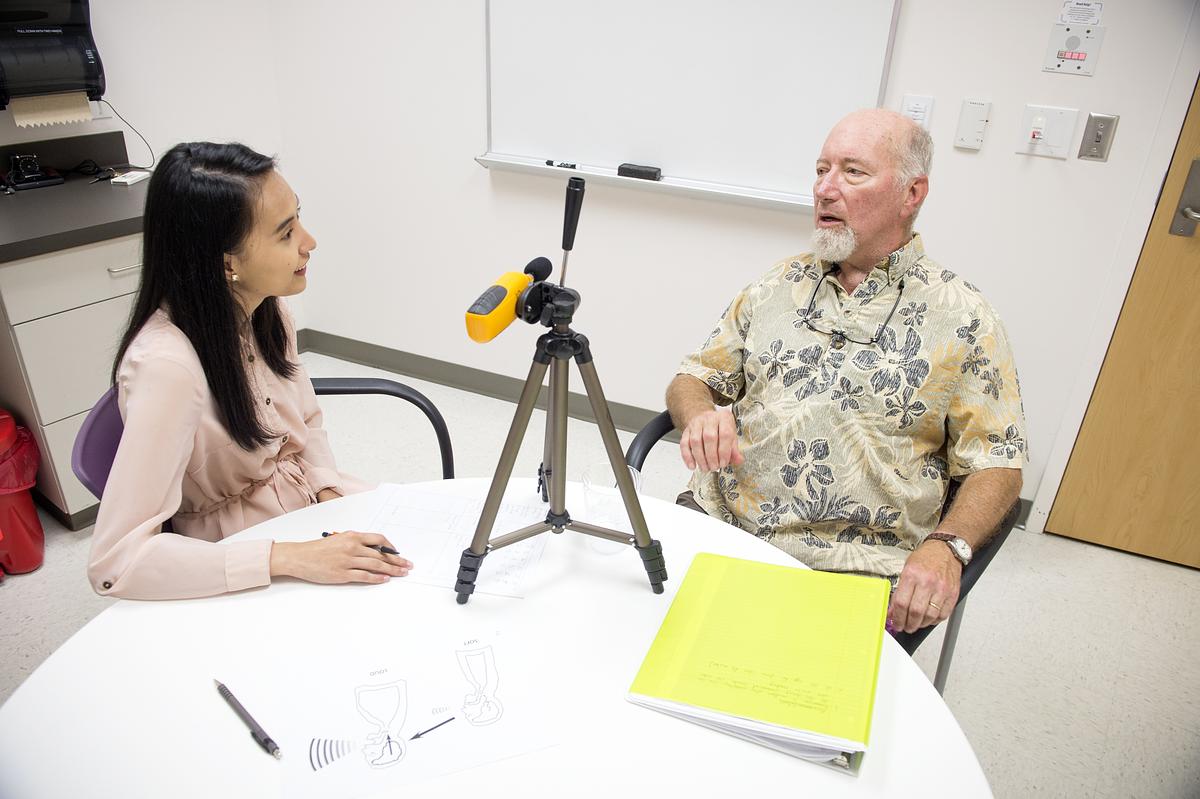
In addition to superior classroom education, students receive hands-on training in the Speech and Hearing Clinic, which serves approximately 75 clients a week and provides a valuable health service to the community. Our students may also choose to get involved in WCU's National Student Speech Language and Hearing Association (NSSLHA) chapter, further augmenting their studies and understanding of the field.
Mission
The fundamental role of WCU is to develop a community of scholarship in which students, faculty members, administrators, and staff members learn and apply the products of learning. The mission of the faculty, staff, and students of the Department of Communication Sciences and Disorders is to engage jointly in the acquisition of knowledge, skills, and dispositions to address communication and its disorders, exercise informed judgments, and accept challenges calling for innovative clinical responses. In the execution of this mission, we are committed to honoring the individual differences and needs of culturally and linguistically diverse populations and growing in awareness, knowledge, and experience to meet the challenges provided by ethical practices, changing populations, and scope of practice demands.
Goals
The nature of the profession, society, the practice of speech-language pathology, and individual settings of service delivery impact the professional world of speech-language pathologists (SLPs). SLPs work from a client-centered framework as members of a large team. Practitioners must be knowledgeable of the world and the profession and be competent in all communication-related tasks requiring specialized skills and training. They must view themselves and all whom they serve as valuable, responsible, and capable. To this end, SLPs must be demonstrate problem-solving skills that require careful reflection, occasional shifts of personal perspective, and informed and effective decision-making. Therefore, the CSD Department has established specific goals considered necessary to prepare SLPs who provide services in the prevention, evaluation, and management of human communication and its disorders and to prepare SLPs who provide services to individuals of all ages and across diverse cultural populations. Students must meet all academic and clinical goals prior to graduation.
Accreditation
The Master of Science (M.S.) program in speech-language pathology {residential education
modality} at 91女神 is accredited by the Council on Academic
Accreditation in Audiology and Speech-Language Pathology (CAA) of the American Speech-Language-Hearing
Association, 2200 Research Boulevard #310, Rockville, MD 20850, 800.498.2071 or 301.296.5700.
Learn More
Strategic Plan
The CSD Strategic Plan is like a roadmap documenting the mission, values, and long-term vision for the program. In the 2024-2025 academic year, CSD identified strategies related to the following themes: Academic & Clinicial Excellence; Student Experience; Regional Development & Engagement; Inclusive Excellence; Responsible Steardship; Employee Excellence; and Vision Advancement. These strategies are realigned annually with those of the College of Health and Human Sciences and the University. Review the 2024-2025 Executive Summary.